
|
|
Fraser told the briefing that Canada has set extra resources in offices in Poland, Austria and Romania to improve capacity to handle a potential influx of applications to come to Canada. "Our goal is to identify the best path forward to allow more Ukrainians to come to Canada easily and safely," Fraser said. The government has also extended temporary status to Ukrainians who are already in Canada on work, visitor and student permits and cannot return home. Nearly 4,000 Ukrainians have been approved to immigrate to Canada since conflict with Russia began, Canada's immigration minister said Monday. The NDP has urged Canada to drop visa requirements for Ukrainians to come to Canada to ensure people seeking safety aren't "subjected to a bureaucratic nightmare."  New measures in place to help people affected by the ongoing situation in Ukraine by Canada:
When reviewing applications, IRCC prioritize it if
In other hand, IRCC invites 1,047 in new PNP Express Entry Draw. On Wednesday, March 2, 2022 IRCC invited PNP candidates in the new invitation round. The cut off was 761.
0 Comments
Canada immigration department raises its goal to welcome 432,000 immigrants in 2022. The goal has raised even higher, planning to welcome 451,000 new immigrants by 2024. Minister for Immigration described "This levels plan is a mix of requirements for our country and our international duties," It focuses on recruiting qualified people who will contribute to the Canadian economy and address the labour deficit, while also acknowledging the value of family reunion and assisting the world's weaker section of population through refugee resettlement. Our focus remains on strengthening our economic comeback by increasing the permanence of newcomers in areas facing serious economic, labour, and demographic issues. I'm pleased of what Canada has accomplished so far, and I can't wait to see how immigrants will continue to make Canada a top option." Canada government has set plan to welcome following number of new immigrant arrivals over the next three years: 2022: 431,645 permanent residents
 The PNP will be the primary admissions program for economic immigrants, with Immigration, Refugees, and Citizenship Canada (IRCC) aiming to admit 83,500 immigrants under the PNP in 2022. Immigration department of Canada invited 1082 Provincial Nominee Program (PNP) candidates with the Comprehensive Ranking Score (CRS) of at least 710 on 16th February 2022. This is the 4th consecutive PNP only draw in the year 2022. In the previous PNP only draw 1070 candidates were invited with minimum score requirement of 674 points.  In past years, Canada has certainly become one of the most popular destinations for immigrants. One of the primary reasons people choose Canada as their preferred immigration destination is the benefits of Canadian immigration regulations. Furthermore, immigrants are tempted to Canada because of its high quality of living, medical benefits, safety and security, beautiful geographical areas, and various career possibilities. In 2018, IT was one of the fastest growing professional sectors in Canada. It will also continue to draw attention in 2022 owing to the developing technology scene, since programming and development talents are in high demand. Canada is ideally positioned to profit on the technology boom, having already begun to integrate emerging technologies such as Artificial Intelligence, Agile delivery, Analytics, Security, and Cloud services. The business-friendly regulations and economy have already enticed multinational corporations such as Google, Microsoft, Amazon, and Facebook to construct distribution facilities in Canada. For its rapid growth, Canada's technology sector has been named "the country's fastest developing industry." Some of the highest-paying positions are offered to the Software Developers in Canada. With an average yearly income of $81,000, Canada's IT business provides some of the top paid employment outside of US cities. Software developers that want to earn the best Canadian wages tend to flock toward places such as Vancouver, Toronto, or Montreal. As more and more talent is available in the different provinces of Canada, the federal government is focused on PNP draws at present. IRCC, Canada invited another 1070 Provincial Nominee Program (PNP) applicants h to apply for permanent residence on February 2, 2022 with a minimum Comprehensive Ranking System (CRS) score of at least 674. Canada initiates employment-friendly programs like the Global Talent Stream and Global Skills Strategy. If your occupation is in demand, such programs make it possible for new immigrants with necessary abilities to get pick among the best Canadian businesses!! Indians have emerged to be one of the most important contributors to Canada's flourishing economy20/1/2022 Top 10 jobs for Indians in Canada Canada is a country that largely relies on immigration to compensate for a scarcity of youthful workers. By 2023, the country is estimated to have accepted nearly 1.2 million migrants. Canada is one of the safest countries in the world, with a low average cost of living. Furthermore, Canadian residents have access to government-funded healthcare, and companies are required to offer adequate health coverage. Jobs in Canada pay an average of 42,450 CAD (INR 2,526,620) per year, or 22 CAD (INR 1,310) per hour for Indians. Let's take a look at the top most in-demand careers along with average annual salary for Indians in Canada.
It's worth noting that Canadian employers prefer university or college graduates with minimum 12-month experience who want to work in the country. If you are dreaming moving to Canada. Book a free consultation session with our team.  Express Entry Results & Statistics Cumulative ITAs
CRS Cutoff Score  Invitations   Canada, IRCC is beginning of the new year inviting 392 Express Entry applicants to apply for permanent residence on January 5,2022. All of the candidates who were invited should have already been nominated through a Provincial Nominee Program (PNP). The cut-off (CRS) rose this time to 808. IRCC invited only PNP applicants to apply for permanent residence in the first Express Entry draw of the year. IRCC has only been inviting PNP applicants since September. The Canadian government has indicated that modifications to Express Entry would be made this year. The Liberal government proposed in the 2021 federal budget to allow the immigration minister more freedom in inviting Express Entry applicants who fit Canada's labour market demands. Earlier that year, in a mandate letter, Prime Minister Justin Trudeau encouraged Immigration Minister Sean Fraser to increase permanent residency paths for international students and temporary foreign workers through Express Entry. The possibility of even greater level of immigration exists due to a variety of variables such as developing labour shortages in Canada. Let us explore your options. Book a consultation session from our expert team!
The administration also reported that the country had surpassed its all-time high for permanent resident landings in a single year. The only other occasion Canada reached the 400,000-immigrant mark was in 1913, but the outbreak of World War I caused a decline in immigration in the years that followed. Canada believes that more immigration would promote economic development and alleviate a deteriorating post-pandemic labour shortage, but new migrants may add fuel to a red-hot property market that the central bank has warned has been fueled by a "sudden flood of investors." Canada's successive governments have depended on immigration to promote economic development. With the epidemic forcing aged Canadians to retire early, in the face of a dwindling fertility rate, which reached a record low last year, luring immigrants has become increasingly crucial. Furthermore, the government seeks high-skilled immigrants who bring in money and earn enough to compete for preferred homes. "Canada needs immigration to create jobs and drive our economic recovery," said Immigration Minister Sean Fraser, according to Reuters. "It's not simply that one in every three Canadian firms is established by an immigrant, along with those newcomers are also helping to address labour shortages."  Every year, over 400,000 new permanent residents arrive in Canada, with around 90,000 of them being Indian nationals. Because of their English language fluency, professional job experience, and high levels of education, Indians are Canada's top supplier of global talent. In the year 2020, despite the fact that the number of applicants invited from India fell to 10%, down from 18% in the previous year, there were still more candidates invited from India than from any other foreign country. India was also the most prevalent citizenship nation among individuals who acquired ITAs, followed by China, Nigeria, Pakistan, and the United Kingdom. Canada, IRCC invited 746 Express Entry applicants to apply for permanent residence on December 22. All of the candidates who were invited should have already been nominated through a Provincial Nominee Program (PNP). The cut-off (CRS) rose this time to 720. IRCC invited record breaking 1032 applicants with scores of at least 698 in the previous draw. While announcing that the Atlantic Immigration Pilot will become a permanent program in 2022, Immigration Minister Sean Fraser stated that Canada would return to admitting immigrants from both within and outside the country. We can anticipate that as we move forward, we will have a healthy mix of professionals who are already in Canada and have some experience in Canada, as well as other professionals who may not yet be here but will soon come to Canada. Book a free consultation from our experts! Expansion in immigration pathways should be the key priority to alleviate labour shortage in Canada.17/12/2021 The pandemic has aggravated Canada's long-standing labour shortages, and there is no easy remedy. In this context Trudeau unveils Canada's new immigration system priorities. According to the Canadian Federation of Independent Business (CFIB), labour shortages affect more than half of small Canadian organizations. These organizations may have been understaffed as a result of challenges in finding, retaining, or getting employees to work the required hours. As a result of these labour shortages, over one-third of firms reported cancelling or delaying projects, as well as rejecting down contracts and sales, in June. Additionally, the firms that report they have enough employees, but at a major additional expense owing to salary hikes, flexible hours, or recruiting bonuses, among other things. According to the CFIB, raising wages is not the solution because higher wages imply higher labour costs, which drive up prices and create inflationary pressure.  Finally, in order to overcome its labour shortages, Canada must tap into as many talent sources as possible, both in the short and long term. Canada now has over 1 million job openings and will continue to have labour market shortages as the country's 9 million baby boomers reach retirement age during the next decade. Since the 1990s, Canada's working-age population has been dropping, and future predictions predict that trend will continue. If nothing changes, Canada will have lost a huge portion of its working-age population by 2050. Addressing labour shortages will need a series of activities over a longer period of time. Improving in automation processes and enhancing the TFWP, may be done in the near run. The more focus must be on the long run labour shortages. This means that governments and businesses must do a better job of determining ways to link under-represented employment groups, newcomers in general, Indigenous peoples, people with disabilities, disenfranchised youth, and others, with relevant work opportunities. Governments have a role to play in alleviating labour shortages, solutions mostly lie with businesses improving salaries and training. But one solution is to expand immigration pathways for skilles workers either temporary or permanent – outside of Canada. Immigration programs can help businesses to overcome the labour shortages. Immigration programs aims to bring more employees into Canada more quickly while also ensuring a suitable fit between immigrants and the roles they fill. A better Immigration Program would be more accessible to a larger range of talents and industries, and would provide additional avenues to permanent residency. Canadian government should focus on increasing the number of pathways available to international worker, international students and temporary foreign workers via Express Entry. Since 2018, Immigration, Refugees, and Citizenship Canada (IRCC) have been supporting a variety of pilot projects geared at assisting minority immigrant women. According to IRCC, One of the programs' goals is to "help minority immigrant women find good, well-paying jobs that set them up for success in the country, by trying to address the hurdles they may face–gender- and race-based discrimination, uncertain or low-income employment, a lack of affordable child care, and poor social supports." For a variety of reasons, the topic of women's job prospects is extremely important to immigrants. Women are just as eager as men to work in occupations that are a good fit for their skills and to advance up the socioeconomic ladder. 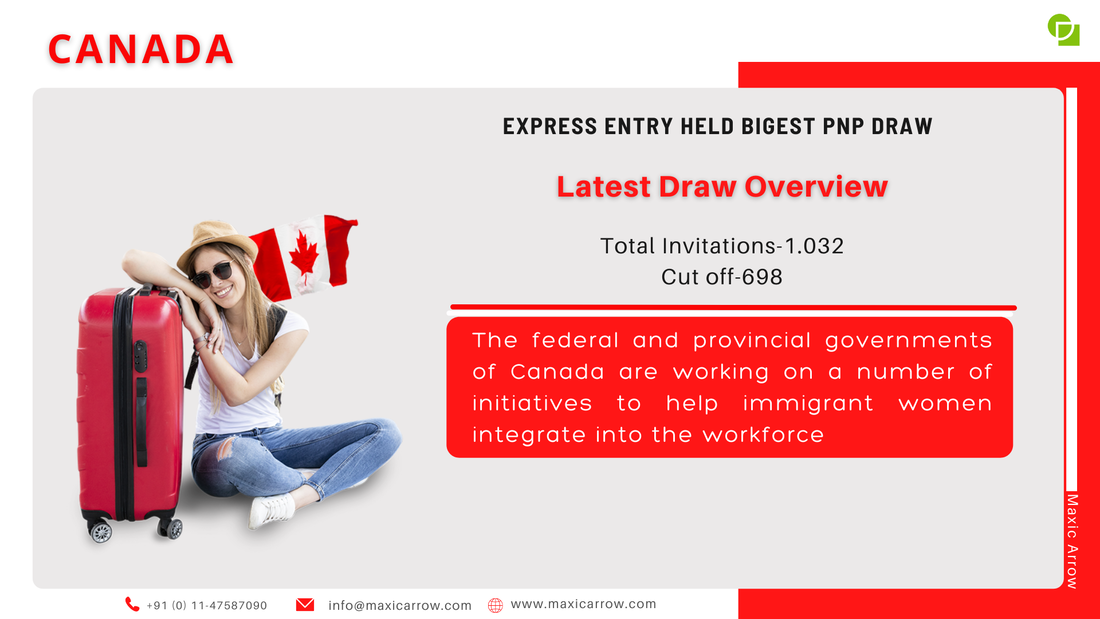 In context to invite more and more immigrants, Canada IRCC held the biggest PNP draw ever inviting 1032 candidates to apply for permanent residence on December 10, 2021. Candidates invited required a minimum Comprehensive Ranking System (CRS) score of at least 698. This is 7th PNP draw in a row. Short-term and long-term labour shortages are now plaguing Canada. In order to overcome labour shortages, the Canadian government and employers must use diverse talent sourcing channels. They must improve and simplify job opportunities for foreign workers. If you are considering relocating to Canada, contact our team of experts. Canada, Most of the ITAs has been issued by IRCC to PNP candidates this year. Here is another round of invitations held on Thursday, November 24, 2021. in this draw Total 613 PNP candidates has been invited to apply for Permanent Residence. Since beginning of the year 2021 Canada has now held 22 Express Entry draws just for PNP candidates. This was the 6th PNP specific draw in the row. PNP draws (CRS) since January 6, 2021 has ranged from the low 813 to 685 till previous draw held on November 10.  As per our experts’ prediction, most awaited FSW draw is likely to come on December 8, 2021. The probability of it happening on this day is currently 13%. Get your application prepared, book a free consultation session with us. |
Maxic ArrowRecent Blogs' Diary Archives
July 2026
Categories
All
|


 RSS Feed